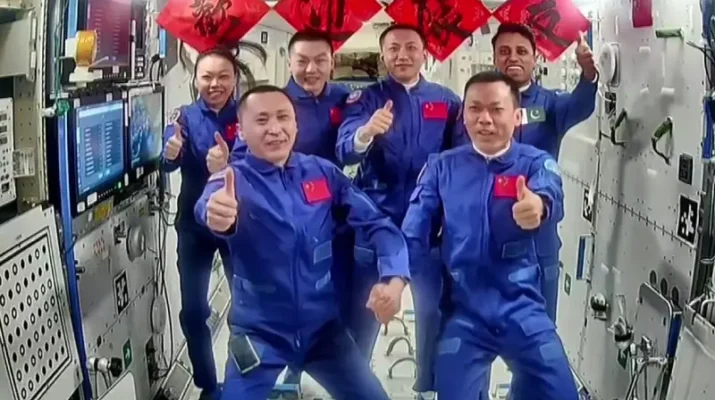

Pakistan’s Zeeshan Ali on Wednesday became the first foreign astronaut to board China’s Tiangong space station, marking a historic moment for his country’s science ambitions and Beijing’s efforts to extend its space diplomacy.
The Shenzhou-24 space flight’s three-man crew entered Tiangong at 2:35pm (0635 GMT), roughly six hours after they took off from the Jiuquan Satellite Launch Centre in northwest China using a Long March-2F rocket.

The 40-year-old pilot, who is the first Pakistani in orbit, is working as a payload specialist and is set to stay at the station for 5 to 10 days.

To prepare for the flight, Ali trained for seven months in Beijing, during which he underwent intensive Chinese-language classes, learning Chinese songs and reading Chinese poetry. He also practised calligraphy and played table tennis.
The Shenzhou-24 crew, which includes Chinese commander Tang Hongbo and flight engineer Wu Yi, was greeted with hugs by the three Shenzhou-23 flight members currently residing at the station, who had also prepared a cake to celebrate.
“As the first foreign crew member to board the China Space Station, I am incredibly excited. China Space Station here I come!” Ali said in Chinese, according to a report from China’s state broadcaster CCTV.

The two crews then took group pictures of the ninth space get-together in China’s aerospace history. They will now start a new in-orbit handover round, Xinhua reported.
Shenzhou-24 had successfully docked with the Tiangong space station three hours and 38 minutes after liftoff, the China Manned Space Agency (CMSA) confirmed.

In the next stage of the mission, Pakistani science payloads will begin in the Wentian and Mengtian labs of the Tiangong space station, according to Suparco’s website for the spaceflight.
A send-off ceremony was also held for three astronauts who make up the mission’s crew at the launch centre before they entered the spacecraft capsule.
The spacecraft successfully separated from the carrier rocket roughly 10 minutes after lift-off and entered orbit, the CMSA said.
“The spacecraft is functioning well. I declare the Shenzhou-24 launch mission a complete success,” an official at the Jiuquan Satellite Launch Centre announced.
90 experiments
China’s Tang Hongbo is commanding the mission, with Wu Yi serving as mission pilot and Ali as payload specialist.
Ali is expected to spend around a week in space, conducting various experiments alongside the Chinese crew. Pakistan’s space agency, Suparco, said Ali would conduct experiments in orbit, including cultivating microalgae as a potential food and oxygen source for future space missions, and testing the effects of spaceflight on quinoa seeds.
Meanwhile, the CMSA said the crew would conduct around 90 experiments during the mission.
The agency said the mission’s objectives included conducting an orbital rotation with the crew of the earlier Shenzhou-23 mission, carrying out routine operations and maintenance of the space station, and continuing space science research, including experiments involving space payloads.
‘Pakistan begins its journey beyond the stars’
Prime Minister Shehbaz Sharif congratulated the nation on astronaut Zeeshan Ali’s departure for the Tiangong space station aboard China’s Shenzhou-24 mission, saying Pakistan had begun its journey “beyond the stars”, the Prime Minister’s Office (PMO) said.
In a statement, the prime minister said the “journey was not just that of one astronaut but of 240 million Pakistanis, particularly the younger generation, scientists and their dreams”.
He said Zeeshan Ali and Khurram Daud had completed their training in China with hard work, discipline and dedication.
Shehbaz said Pakistan would become the first country after China to travel to the Tiangong space station, calling the development a reflection of the “ironclad friendship” between the two countries.
He thanked China for making Pakistan part of the historic mission, adding that the two countries were now working together not only for peace and development on Earth but also in space.
The prime minister also paid tribute to Suparco, universities and scientists involved in the scientific experiments being sent into space.
The premier said the combined efforts of the armed forces, national institutions, scientists and young people were helping Pakistan make progress in space research and advanced science.
Staff Admiral Naveed Ashraf, Chief of the Air Staff Air Chief Marshal Zaheer Ahmed Baber Sidhu, and Commander National Strategic Command General Syed Aamer Raza extended felicitations on behalf of the Armed Forces of Pakistan.
The ISPR said the journey of Zeeshan Ali, Pakistan’s first astronaut and the first foreign astronaut to travel to the Chinese space station, marked a defining moment in the country’s scientific and technological advancement and was a source of immense pride for the nation.
The military leadership commended Suparco’s scientists, engineers and technical teams for their dedication, professionalism and sustained efforts in achieving the milestone.
It also appreciated the leadership, government and people of China for their support and cooperation in enabling Pakistan to achieve the milestone.
The ISPR said the friendship between Pakistan and China had reached new heights, extending beyond the frontiers of Earth into outer space.
It added that Pakistan’s entry into human spaceflight reflected the potential of its human capital, scientific ingenuity and technological capabilities, and would inspire future generations to pursue excellence in science, technology and innovation.
The armed forces also wished Zeeshan Ali success and a safe return to Earth.
Planning Minister Ahsan Iqbal, who is in China, witnessed the send-off and the mission’s launch.
Later, he posted on X: “As Shenzhou-24 lifts off this morning, Nov 25, carrying Zeeshan Ali, Pakistan’s first astronaut, a new era begins for Pakistan’s space programme. With him, the Pakistani flag rises into orbit, lifting the hopes and aspirations of 260 million Pakistanis for technological advancement and space exploration. From highways to information super highways to skyways, Pakistan-China friendship and CPEC rises higher than the skies.
“This is Pakistan’s URAAN (flight) into space, and it is only the beginning of a brighter and more glorious future.
Zardari, Xi exchange letters
Meanwhile, the Presidency in Islamabad said in a statement that President Asif Ali Zardari had exchanged letters with his Chinese counterpart on the “landmark Pakistan-China space cooperation achievement”.
The statement said the two leaders congratulated each other on the “historic milestone in Pakistan-China space cooperation, marked by the first spaceflight of a Pakistani astronaut to China’s space station aboard the Shenzhou spacecraft, making him the first foreign astronaut to enter the Chinese space station”.
President Zardari extended felicitations to the government and people of China and expressed his “profound appreciation” for selecting Pakistan as the first foreign partner in China’s manned space programme, the statement said. It added that he further acknowledged the “invaluable support, professionalism and dedication” of the CMSA and the Astronaut Centre of China in making the collaboration possible.
President Zardari said the achievement “reflects China’s remarkable progress in space science and technology as well as its commitment to international cooperation in the peaceful exploration and use of outer space”
Beijing has poured billions into China’s space programme as it aims to land astronauts on the Moon before 2030, a race in which the United States is also competing with its Artemis programme.